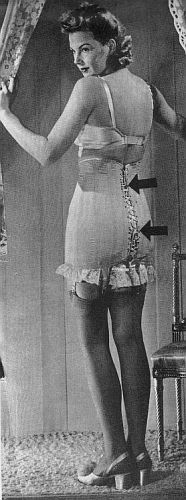
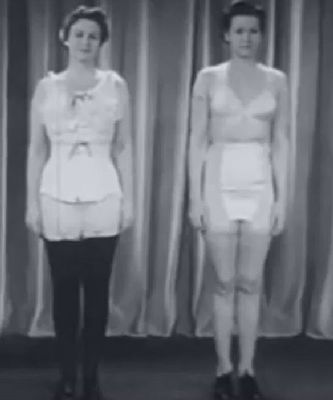
In this post at fashion stuffs we are going to talk about the corsets of women's in 1940.

With eighty gowns, ranging from classic and elegant to outrageous—created by
celebrated designers Issey Miyake, Kenzo Takada, Rei Kawakubu, Yohji Yamamoto,
Junya Watanabe, Jun Takahashi and others—videos of runway shows,
artistphotographs, magazines, and ephemera designed by renowned international artists
such as
Gilbert & George and Cindy Sherman, an exhilarating experience
awaits viewers of this extraordinary exhibition.
By the mid-1940s, many women had abandoned the single-piece corset in favor of
panties and structured bras that lifted and accentuated the bust line. In 1946,
a well-endowed Jane Russell appeared onscreen in a cantilever bra designed by
Howard Hughes, prefiguring the bullet-bra 1950s and the reign of the sweater
girl. Loose-fitting cardigans were also popular, particularly on college
campuses.
This was an explosive new beginning of what is now three decades of
innovative design that has in turn influenced and reshaped our Western
aesthetics of dress. Curated by Akiko Fukai, director of the Kyoto Fashion
Institute, the exhibition showcases the early emphasis on light and shadow, and
the increasingly diverse, innovative designs that range from the deconstruction
and reinvention of Western couture models to brightly colored designs that are
inspired by contemporary street fashion.
The virtual disappearance of French fashion houses during the war led American
designers to explore their own creativity. Designers like Bonnie Cashin and
Claire McCardell were instrumental in the creation of sportswear, that
singularly American look featuring coordinated separates that could be worn in
layers or in various combinations. The trend not only gave women increased
options and made it appear as if they had more clothes than they actually did,
but also blurred the line between couture and ready-to-wear by showing women
they could be both chic and comfortable without spending a fortune.
In the 1970s Japanese designers
Kenzo Takada and Issey Miyake had already
gained recognition in the West, but it is in the 1980s that Japanese designers
emerged with an entirely new aesthetic. In the summer of 1983, Rei Kawakubo and
Yohji Yamamoto brought forth a stark new aesthetic at the Paris runway shows.
Based on monochrome black and white, they presented asymmetric and at times
perforated dresses, which loosely described the female silhouette. These
designs were recognized as a radical counterproposal to Western notions of the
fitted form and gained instant notoriety.

By the late 1940s, women craved a return to glamor and designers obliged with
swirling skirts and shimmering evening gowns inspired by film stars like Ingrid
Bergman, Barbara Stanwyck and Joan Crawford.
I hope that you enjoyed this post and i please bookmark
fashion stuffs for more information about fashion stuff.
P.S. Photos have been taken from corsetiere.net/